
As my Buyer Client, I represent your interests in the transaction and the listing agent represents the Seller
A personal note to our Buyer Clients,
In doing business it is important that we take a few minutes to discuss our working relationship together.
As of July 1, 2012, Virginia Law now requires that a BUYER and a BROKER have a “WRITTEN” agreement (not just verbal). By law, Agents in Virginia can only show homes and work with a Buyer after both have signed this Buyer Brokerage Agreement.
Remember that your Charlottesville Solutions Agent is representing your interests, as our Buyer at Solutions, we have a policy to NOT practice dual agency representation. You are in good hands when looking at Charlottesville homes.
There are Three main parts to a Buyer Brokerage Agreement
Term, Duties and Compensation outlined below.
Term
This is the length of our agreement. To start with and to increase our clients comfort, our agents are willing to initially enter into a Buyer Brokerage Agreement for a single day.
We do this so our buyer clients are clear that we are working for their best interests. At the end of that initial period, both you and your agent can decide to extend the agreement and, if so, for how long.
Duties
As your Exclusive Buyers Agent, we are working for your best interests at all times. Rather then simply show homes, our agents will help Buyer clients through the entire process of finding and closing on the perfect home. At all times, your buyers agent is working for your best interests and not the interests of the seller. In return, our clients agree to work with us as their exclusive buyers agent. This is what is meant by an “Exclusive Right To Represent Buyer Agreement.”
You agree to work exclusively with your Buyers Agent.
Compensation
In the Buyer Broker Agreement, there is a Fee determined by either a percentage or a dollar amount of compensation.
NOTE: “Broker may receive compensation offered by the Listing Firm to a buyer’s broker or paid by a seller, which compensation, if any is offered, will be credited against the Fee due by Buyer to Broker.”
This is one of the key benefits to using a buyer’s agent. The seller has already offered compensation when they list the home. This compensation is credited against any Fee.
Below is a copy of the Standard Buyer Brokerage Agreement which we will discuss when we meet. Our Buyer’s Agents are happy to explain the details to you if you have any further questions.
Sample Buyer Broker Agreement
(Contact your Solutions Agent for latest version)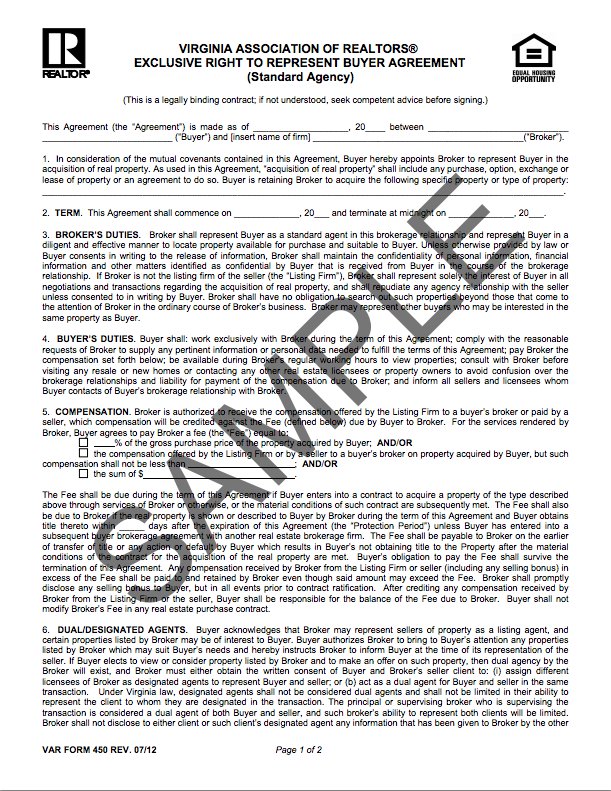
Keep in mind that as your Exclusive Buyer’s Agent, it is our responsibility to provide you with our best advice on the market, to negotiate for you the best possible price, and to assist you in creating a transaction that assures your protection.
At Solutions, our legal responsibility is to put the interests of our Client above those of everyone else. This includes our brokerage firm and the individual agents.
Our Agents at Solutions, are looking forward to helping you find the perfect Charlottesville home.
Ref: Why is my Agent asking me to sign a Buyer Broker